Showing posts with label bees. Show all posts

Tuesday, April 7, 2015

Try, Try, Try Again


We've kept bees for several years now, but only one hive.  For some reason, keeping a second successful hive eludes us.  Our one hive really thrives.  It is so strong that during the ice storm last year a limb fell on it and blew it apart.  We found it lying on the ground in pieces with a cluster in one of the boxes.  We put it back together and expected the worst.  Not only did it survive, but we harvested honey all summer from it.


Apparently even an ice storm can't take down our one hive, but when we try for a second one, it fails, every time. We've bought packages of bees more than once, replaced queens, caught swarms, you name it, we've tried it with the exception of splitting our hive.  So, this year I decided to try splitting our hive.  Why would I keep trying to have a second hive after so many failed attempts?  Well, I'm as stubborn as a mule and a sore loser.  You can ask my husband.

Splitting the hive means basically that.  You try to divide the population and put one half in another hive.  It's a man-made swarm.  As the population builds up in the hive, it becomes crowded which triggers a swarm, which is a natural split.  When bees swarm, the mother queen leaves with a portion of the population, and the newly emerged queen stays and takes over the hive.  With it being early spring, I knew they were building up for a swarm soon so I decided to try to beat them to the punch.  So a few weeks ago, a friend came over to help me.

The goal is to take frames of brood that have all stages of development, eggs, larvae, and capped brood as well as cells of pollen and honey and move them to a new hive.  You replace the frames you take from the original hive with empty frames so the queen has room to lay more eggs.  It's great if you can find your queen in the original hive as you can make sure she stays where she is, but if you can't find your queen, you can either let each new colony make a queen, which they will naturally do in the absence of one or you can add a queen.  Since I have failed so many times I decided not to spend anymore money and to let nature take its course and let each hive rear a queen if there wasn't one.  A few of the frames had queen cells so we left them on the off chance that a queen wasn't present.  There was capped honey already in the hive so we gave each hive a frame or two of honey to help feed them while they transitioned.  We also made sure each hive had approximately the same amount of bees.  Of course, the foragers that were out foraging were going to come back to the original hive.  But, we were hoping any foragers that got dumped in the new hive would reorient themselves and stay with the new hive. Often beekeepers move the new hive several miles away so the foragers in the new hive have to reorient themselves, but I really didn't have the means to do that, so I took a chance.

The original hive recovered quickly and even swarmed about a week ago.  I imagine our original queen was left in that hive and one of the queen cells we left as a safety precaution hatched so it swarmed.  I'm fine with that because it's still a really strong hive.  Well, low and behold, I went out to observe yesterday and saw bees bringing in pollen on the split hive.  This video shows foragers coming in and going out.  It's still a weak hive as it had to rear a queen and has to build up its population, but I'm encouraged!  


Please wish me luck!

Happy homesteading,

Candace


Saturday, March 29, 2014

Buzz, Buzz, Installing Bees

When we first got bees several years ago, we ordered and installed two colonies.  One of them left after two days!  Everybody, gone!  We didn't replace them and since then we've been flying solo with one hive. 


Well, one hive is great, but when an ice storm comes along and a fallen limb blows apart the only one you have, you decide a second hive might not be such a bad thing.  Though this scene looked bad and we questioned whether they would survive, there was still a cluster in one of the hive boxes, so I assumed the queen was still alive.  We put everything back together, fed them sugar water for a few days and watched and waited.  I checked them after a week or so, and I saw capped brood, which means babies on the way and a laying queen, pollen and the start of honey.  As of today, they are working like gangbusters bringing in pollen and nectar.

I picked up and installed my second colony today.


When you order a package of bees, this is what you get. This is 3 pounds of bees. The small rectangular box beside it is called the queen cage, and it holds the queen as well as a few of her attendants.


Here is a close-up of the queen cage.  The white end is actually candy, and this is what she and her attendants eat while trapped in her cage.


The end of the queen cage with the candy is capped with a small cork. The cork is removed to give the new bees access to the candy. They will eat their way through the candy to release the queen. Once the cork is removed, the queen box is suspended in the hive body where the bees will be installed. She is still protected by her cage, but she will be able to send out pheromones to establish herself as queen. At this point, she is not their queen, but by the time they get through the candy and release her, she should have sent out enough pheromones to establish herself as their new queen.


This is where the bees are going to be dumped. It's a hive body with 10 frames.


The blue push pin is holding the queen cage in place. The top is pried off the package of bees and you basically shake them out of the package into the hive. Most of them come out in a large mass and they proceed to work their way down into the hive body.


After you've shaken out as many bees as possible, the package is placed in front of the hive to encourage the rest of the bees to migrate into the hive body.


Finish with a nice container of sugar water to feed them since they don't have any honey or pollen collected yet.  Let's hope this one stays put!

Happy beekeeping,

Candace

Tuesday, May 29, 2012

Yippee!

There was no rest for the weary this weekend.  Earlier this spring, we had seven trees taken down in my neighbor's yard.  Six of them were hardwoods, so we had the tree service leave them and only take the pine.  What they left was stacked fairly neatly along the retaining wall that runs between our yards.  Compared to the mess that is our neighbor's yard, they really didn't make it look any worse or any better.  We have been making an effort to tackle this pile of trees along with all of our other projects, but we had not made it a priority, mainly because our neighbor really didn't care when we did it and it seemed so overwhelming that knocking away at it piece by piece seemed the best strategy for us.  Well, the city cares.  Based on a call about another yard, a city employee was driving down our street and noticed the felled trees.  He knocked on my neighbor's door and told him he needed to clean up his yard, especially the backyard, which was overrun with poison ivy.  He also told him he needed to make some progress on the trees.  Our neighbor then received a letter giving him 10 days to get the job done. 

Not getting this project finished has really been bothering me.  I don't like to leave things undone.  So, I'm glad the city set a time limit for us; otherwise, we would have continued knocking away little bits of it and not making it the priority it should be.  So, this weekend, we tackled the remaining trees and got them all cut up and moved to our wood pile.  Our neighbor's yard looks much better as I knew it would, and I feel relief at having this project no longer hanging over my head.

When we started working yesterday, we knew we had probably a full day's work ahead of us.  The trees has all been cut to length for splitting, but we knew we still had to load the truck several times, pull into our driveway, and wheelbarrow this wood to the wood pile.  I had already filled and wheelbarrowed two truck loads of wood the day before while Nate was at work.  Our neighbor had told us someone was coming to take care of the yard, and as we were beginning work, the yard guy and his son pulled up.  He had been hired to take care of the front and back yards and been told to work around the wood.  While we were loading wood, we overheard him talking to our neighbor about the poison ivy and Roundup.  My heart skipped a beat.  Nate went over and told him we had honeybees and that we really didn't want him using Roundup.  Of course, we can't control what our neighbor does, and he would not back down on the use of Roundup.  This started a conversation with the yard guy about our bees and our urban farm.  They both took a tour of the place and offered to help us with the rest of the wood.  They didn't ask for any payment for helping, but Nate helped with the yard and I sent them home with some jams and honey.  After they finished, the man told me he sparingly used the Roundup and if he saw any type of flower in an area where he was spraying, he pinched it off just in case a bee might want to visit it.  I know he was being paid to spray Roundup, but I certainly appreciate the extra care he took to minimize any damage that might result.  He certainly wasn't obligated to us to take any special care. 

At one point, when his son was looking at the chickens and rabbits, he said, "Y'all are old-fashioned."  I smiled and said, "We are old-fashioned, and we like it that way."  I could tell he said it in awe and not like we were strange.  At one point, he also said our house and yard are his mother's dream.  We have a very humble house by most standards, but that comment made me feel blessed in so many ways. 

So, what to us looked to be a weekend worth of heavy labor ended up being laced with neighborly support and consideration.  They live in the neighborhood next to ours and know our across-the-street neighbor, so in our world, they are neighbors.  The best part is the project is DONE!  CROSS IT OFF MY LIST! 

Happy homesteading,

Candace

Sunday, May 13, 2012

Sugar, Sugar, Ahhh, Honey Honey, Ahh, Bunny Bunny, Ahh, Berry Berry

We're going into our third year of beekeeping.  The first year was a total failure for several reasons.  We didn't even make it to winter with the two hives.  Last spring we started over with one hive and while we had some honey at the end of summer, we left it for the bees to help them through the winter.  I am pleased to say that over the last two weekends we have extracted our first honey.  We've processed one full super consisting of ten frames and four frames from another super.  We still have six frames in the 2nd super that are almost capped so we expect to harvest them in the near future.  Additionally we have another 10 frame super that is full of honey but yet to be capped.  I cannot express how utterly excited and pleased I am about this.  All of our frustration, disappointment, sweat, bee stings and tears have come to fruition in the form of 28 pints of honey so far.  We are averaging two pints per frame, so if we harvest the six frames that are almost capped, we should get another 10-12 pints of honey.

All of the angora babies have new homes.  I'm always sad to see them go, but I'm happy with the people who bought them so that makes the letting go easier.  Both of the does went to the same home, so they get to be sisters together.  The new owner emailed me a few days ago with photos and told me they have personalities plus.  She has named them Lucy and Ethel because of their craziness.  She said they have already been to show and tell for three different classes at school. 

the blue tort doe


the blue-pointed white doe (She was our absolute favorite, and I almost kept her.  I mean, look at that pose.  She knows she's cute.)


the blue-pointed white buck


This mess of bunnies is my first meat rabbit litter.  They just hit six weeks old and are growing well.  It's time to wean them from mama. 


Yesterday, I was given a huge bucket of organic strawberries, so canning season started early this year.  I put up (12) 12 oz. and (7) 8 oz. jars of Strawberry Ginger Jam today.  It is so freakin' delicious!  It has been ages since we had strawberry jam mainly because my strawberry growing skills are less than ideal, and I don't buy strawberries because I worry about the chemicals that have been used on them. 

That's it for now, folks!

Happy homesteading,


Candace

Thursday, March 8, 2012

Toot! Toot!, Angora Babies, and What Did I Get Myself Into?

That's me tooting my own horn.  Just joking.  I took my practical today for beekeeping and am now a certified beekeeper.  Believe me, there are no special privileges or awards.  It just shows I have hands-on practical knowledge of beekeeping.  I can point out certain elements of a hive and answer some "what-if" questions.  It doesn't mean I'm a successful beekeeper, if harvesting honey is the benchmark.  Though the hive is strong coming into spring, and I'm hopeful honey is in our future.  During the practical exam, we noted several queen cells as well as evidence of a productive queen.  We cut out the queen cells to prevent swarming.  They have plowed through the honey I noted a few weeks ago but are in the process of capping more.  I don't believe in feeding sugar water for the sake of harvesting honey.  I believe eating their own honey will do more for them than substituting a substandard food.  So, we will be patient for a honey harvest.  Spring has sprung around here, and everything is starting to bloom so they should have good nectar sources in the coming weeks.  They are doing a stellar job of collecting pollen.  The hive was loaded with pollen.  We didn't see anymore evidence of mites, so the powdered sugar may have done the trick.  I will check them in another 10-14 days for honey production progress and queen cells.

Olivia, my English Angora, gave birth to four kits last night/this morning.  I found them this morning at various places in the nest box.  They were cold to the touch, except one, so I rushed them into the house and placed them on a towel over a heating pad.  Three of them were really fat and healthy looking, and I could tell they had nursed because they looked like balloons about to pop.  I brought in Olivia and tried to get the runt to suckle, but it just didn't have the strength.  I also tried to nurse it with a dropper, but it didn't respond to that either.  It died shortly after that.  They are now snuggled together in the nest box covered with a layer of Olivia's wool.  Here's a picture of the four.  You can see how much smaller the runt is next to the other three.  They are the most vulnerable the first ten days, so please wish them, Olivia and me good luck. 


I opened my mouth and out popped, "Yes, I'll do it."  What is it that I agreed to do you may ask?  I agreed to speak this Saturday at a local health food store on the subject of Urban Homesteading.  The store is hosting an all day event with different speakers on subjects such as beekeeping and emergency preparedness.  What have I gotten myself into?  I'm going with an arsenal of photos, stories, and hard lessons learned.  Any advice or encouragement would be greatly appreciated right now!

Happy homesteading,

Candace

Wednesday, February 22, 2012

Observations of a Bee Hive

The pedigree of honey Does not concern the bee; A clover, any time, to him Is aristocracy.
~ Emily Dickinson

I've had so much going on around here lately between work, which has been very stressful and getting the basics done around here that finding time to post has been difficult.  Not to mention I have also contracted a serious case of writer's block.  I'm going to attribute that to just being tuckered out.  Every time I sit down to write, I just can't get the words to flow.  Everything I write seems stilted and boring.  In any case, the best way to get over a hump is just to push yourself over it.  So, I'm going to start with our latest hive inspection and just start typing.  I hope you don't mind.

While we've been experiencing a cold snap the past week or so, we had the luxury of some spring-like weather a few weeks ago.  Sunny, in the 60s and little to no wind make for perfect condition to do an early spring check on our bee hive.  Deborah, who is my mentor, and I approached the hive and just observed the activity for a minute or two.  The bees were busy bringing in pollen, but Deborah also noted a dead larvae at the entrance.  Her first impression was mites, so we knew we had to pay close attention once in the hive.  Upon opening the hive, we noticed good activity in the top super.  I was extremely excited to note that several frames were filled top to bottom with capped honey, picture perfect I might add.  While I am itching to harvest my first honey, it's still too early in the season to start taking as we always get another cold snap around the first of April.  I want them to have good stores to eat between now and then.  The second box down was our first hive body.  It was full of capped and uncapped brood as well as capped honey and plentiful pollen.  The different colors of the pollen collected created a quilt effect, red, yellow, orange, white.  It was lovely.  The bottom hive body was not as full of brood, either capped or uncapped, and since bees travel upward, it was apparent the queen was spending most of her time in the top hive body.  We don't want them to feel crowding and start thinking about swarming, so we flipped the top and bottom hive bodies and put the full one on the bottom.  Now the queen can still stay in the top hive body and feel like she has plenty of space to lay eggs.  Since we have a partially full super of honey, we also added another super on the top.  Now the bees can continue storing honey upward.  We also did not find any swarm cells.  Members of my bee club are already dealing with swarms, so diligence is key right now. 

Okay, that was the good stuff.  Now for the bad stuff.  We have mites and a virus associated with mites called deformed wing virus.  We spotted one bee with deformed wing virus, which means the wings are shriveled up.  To treat the mites, we dusted all of the frames and bees with powdered sugar.  This is supposed to be a non-chemical, very effective treatment.  The bees start grooming themselves to get the sugar off, and in doing so, dislodge the mites.  The mites fall to the ground and die.  I imagine it's basically the same principle as a chicken taking a dust bath.  The hive beetles persist, but that is to be expected in almost any hive.  The way we handle hive beetles is based on a strategy given to us by a beekeeping with many years of beekeeping under his belt.  Instead of using an inner cover, he places a sheet of plastic over the top of the super and then places the outer cover.  The bees glue down the plastic with propolis (bee glue made from plant resins to seal cavities and keep out invaders).  They actually create little tunnels with the propolis and trap the hive beetles in the tunnel.  Once you take the outer cover off and expose the plastic, you can squash the hive beetles that are trapped at the top.  Once a hive beetles is dead, it is dragged down into the hive by a housekeeping bee and discarded.  It is so interesting to watch the bees pull the dead hive beetle away.  Of course, there are other methods to deal with hive beetles, but that's the one we have adopted. 

Another inspection is due, so hopefully the powdered sugar will have done some good.

Happy beekeeping,

Candace

Wednesday, December 28, 2011

Bees in the Broccoli

On nice sunny days, the bees come out of their cluster to forage and take care of some housekeeping.  I've been sick and that caused me to not harvest my broccoli in a timely manner.  On my first day out of the house in several days, I'm happy to see the bees taking advantage of my delay.


Happy foraging,

Candace

Thursday, November 24, 2011

Bee Report Card

My friend and fellow beekeeper, Deborah, came over a few days ago to go through our hive with me.  She has several years' experience keeping bees and I can use all the help I can get.  Last year, neither of our hives made it to winter, but this year we've made it, so I want to make sure we do everything we can to help them make it through the winter. 

The day was perfect, sunny and in the high 70s, and most of the bees were out foraging.  I must admit, Nate and I have been very discouraged with our beekeeping.  It seems like everything that can go wrong with a hive has for us.  So, I didn't have high hopes.  I expected Deborah to open the hive and go running from the scene.  Our bees have insisted on building burr comb on the frames despite our attempt to keep the bee space correct, so the top two supers were connected by comb extending from the bottom of one frame to the top of another.  A few of the frames were also connected by comb.  We had to pry them apart.  Deborah explained that they are going to build comb the way they want to build it, and we have to work around it.  Good enough for me.  But, the good news is the comb we cut away contained honey, so we put it in a bowl for them to collect and restore.  They had almost a full super of honey and more stored in the hive body.  We also had capped and uncapped brood, which means we still have an active queen.  We didn't have any queen cells, another plus.  One thing Deborah noted is the amount of drones in the hive.  Normally the drones are kicked out for the winter since they don't really contribute to the work force and are extra bodies to feed.  The weather has been so warm lately that the hive probably doesn't think it's winter yet, so it hasn't banished the drones.  Their days are numbered though.  One negative was that we have a high number of hive beetles, so we need to address them. 

I checked on them the next day, and they were all over the comb I cut out, collecting the honey and taking it back to the hive.  Deborah explained how to process the comb to clean and separate the wax from the junk.  Once the bees clean out the honey, I plan to get that done.  I see lip balm and other goodies in my future.

Overall, we're looking good for winter.  I would give us a B-.

Happy beekeeping,

Candace       

Wednesday, August 17, 2011

Bee Check and Unidentified Vine

Because it has been so hot and also because we have been slightly frustrated with the beekeeping, we recently adopted a new approach:  Let the bees be.  This is our 2nd season beekeeping, and our first season was a total disaster.  This year we've done better than last.  This time last year, we didn't have any bees.  One reason we've been frustrated is because up until recently the bees have been very aggressive, much more agressive than last year's bees.  So we've stayed away.  We know we had a swarm, and I believe I mentioned that the last time we were messing with the hive, the bees didn't seem aggressive.  I know we have a new queen, and she's much nicer than the last one.  So, checking the hive this evening was not stressful like it has been so far this year.  The bees were not buzzing us and gathering on our veils.  We were able to check both brood boxes and the honey super without fear.  I've always been told if you have an aggressive queen to replace her, but nature did that for us with the swarm. 

I'm learning to follow my instincts when it comes to beekeeping.  It's about looking at the facts and clues in front of you (and there as SO many little things to look for) and making a decision based on the given situation and your knowledge base.  No one will give you a definitive answer for any one problem.  Some beekeepers will say we made the wrong decisions, while others will say we made the right ones.  One thing I noticed this evening was the lack of stored honey the hive had, both in the brood boxes and in the honey super.  About a month or two back, a fellow beekeeper told me in times of draught, when no nectar is flowing, and the bees really have no source of food, they will eat their stored honey to survive.  We've definitely been experiencing a drought, so my instinct was to start feeding them sugar water again.  I called my friend to bounce the idea off her, and she said she went to extract honey from a super that was full a few weeks ago, and by the time she went to extract it, the super was practically empty.  The bees had eaten the honey to survive.  She said feeding them would be a proactive way to help them start storing for winter.  So, feeding them is what I'm doing. 

We appear to have a very productive queen evidenced by this beautiful capped brood:


I feel like we are back on target with the bees, and while we are definitely not going to harvest any honey this year, if we can keep them alive through the winter, I have confidence we'll have some next year.  Here's to hoping!

Now, I need help identifying this vine.  It's growing along the back fence that separates us from our back neighbor.  I suspect it's a muscadine vine, but I thought muscadines were larger.  The "grapes" are about the size of blueberries, and when I squeezed one, the inside texture was like a grape, and it had 4 "grape" seeds in it.  Also, the juice on my fingers tasted very grapey.  Since I haven't id'd it yet, I haven't eaten one, so I don't know if the skin is bitter.  The fact that I haven't keeled over from licking the juice is a good sign, I think.  What keeps me from determining it's a muscadine are the leaves.  The pictures I've seen online of muscadine leaves are different.  Any help is appreciated.


Happy homesteading,


Candace


Wednesday, June 15, 2011

A Bit of Sweetness

We may, we may, we may have honey on the way! 

We are down to one hive now.  The other one that had all of the queen issues didn't make it.  While we were checking our remaining hive last week, we could not find our queen and we did not see the different stages of egg production we are supposed to look for.  We also found at least a dozen queen cells.  So, we had to make a decision.  We've found, at least in our experience, beekeeping is about making hard decisions.

Our queen may have been in the hive somewhere, and we just missed her.  She pretty easy to spot because she has a huge bright blue spot on her.  I was leaning to not having a queen because of the lack of egg laying.  If she was in the hive, cutting out all of the queen cells was the solution to prevent a swarm.  Or, we could split the hive and start a second one.  If she wasn't in the hive, we needed at least one of the queen cells to get a new queen.  This was our mistake last year.  We killed a viable necessary queen cell without knowing we had lost our queen.  So, we decided to leave two queen cells.  The first queen that hatches will seek out any other queen cells and destroy them.  Problem solved.  If our original queen is still in the hive, and the queen cells hatches, we have a swarm on our hands.  The mother queen will leave with a mass of bees.  She's clipped, so she won't go very high or very far.  We have not seen a swarm, but that doesn't mean it hasn't happened.  I suspect something happened to our queen and once a new one hatches, it will be business as usual.

So, we've been letting this drama play out, but in the meantime, we decided to check the progress of the honey super.  Almost every frame is drawn out with comb, and I peaked in and saw capped honey.  I really did!  I could smell it too!  We placed a second super over the first one so they could start drawing out comb on those frames.

I've placed a call to our beekeeping friend to find out what to do with the super of honey.  If it were closer to winter, I know we would leave it, but with it being only June, we may have the opportunity to at least harvest a frame or two.  Once, I hear from her, I'll let you know.

If we do get honey, it will be the most expensive honey we will ever eat!  Nate said we should put it in the bathtub and roll around in it.  He's weird that way.  Regardless, we may, we may, we may have honey on the way!

Happy homesteading,

Candace  

Tuesday, June 7, 2011

Roll Call

So, I'm stealing Jenna's idea at Cold Antler Farm for a roll call.  I hope she doesn't mind, but it's such a great idea, and it's a fun way to see and appreciate where you are on your journey.  Feel free to sound off.

1 girl
1 boy
3 cats
5 hens
1 bee hive
2 angora rabbits
Fruits:  blackberries, raspberries, strawberries, 2 fig trees, 1 meyer lemon, 1 orange tree, 4 blueberry bushes, 1 peach tree, 2 apple trees, 1 loquat tree, 1 banana tree
Garden:  spread all over my front and back yards:  eggplants, yellow squash, zucchini, garden huckleberries, ground cherries, peppers, swiss chard, cucumbers, pole beans, lima beans, mexican sour gherkins, winter squash, various annual and perennial herbs, beets, melons , carrots, , tomatoes
Happy homesteading,

Candace

Sunday, May 1, 2011

The Five Queens of Colony Two

Oh, the trials and tribulations of beekeeping.  I tell you, if it can happen in beekeeping, it has or is happening to us.  The fact that we continue to persevere means we're really stupid and don't know when to quit or we just aren't quitters (yet). 

This is the story of a chemically-murdered queen, a queen-cell queen, an unprotected installed queen, a pseudo usurper queen, and a protected installed queen.  This saga is almost as bad as Henry VIII's parade of queens and almost like them:  divorced, beheaded, died, divorced, beheaded, widowed.  I love Anne Boleyn by the way. 

We had a swarm delivered to us three weeks ago.  The person who delivered it discovered once it was delivered and opened that it didn't have a queen because he killed her with miticide (ugh!).  That's one queen down.  A queen cell was naturally formed to replace the queen the colony lost, but the person who brought the swarm to us tried to rectify the situation by bringing us a new queen.  He installed her directly into the hive unprotected, and they immediately balled her and more than likely killed her.  When he installed the queen, I asked him if we needed to destroy the queen cell or leave it.  He said leave it and check it in a few days.  In the meantime, a worker bee decided she wanted to be queen, and she started laying eggs, which if you know anything about beekeeping, you know she can only lay drone (male) eggs.  A pseudo queen bee does not a queen make.  This also told us that the installed queen did not survive.  Now, back to the queen cell, she hatched, and up until yesterday, we were hoping she was still in there even though we had a usurper pseudo worker bee queen on our hands.  If the hatched queen was indeed still in the hive, we were waiting to give her time to make her mating flights and assume her throne.  We checked the colony yesterday and could not find her or any evidence she was present. 

So that brings us to our last queen, the protected installed queen.  Believe me, she will be our last queen for this colony.  We bought her today locally, and she came in a Benton queen cage.  We were told this is a risky attempt at re-queening because once a worker bee starts laying, it's hard to convince the rest of the colony a new queen is needed.  They see eggs being laid and they go about their respective jobs.  Everything to them is dandy in the bee world.  So to help ease her transition to the colony, we took two frames containing capped and uncapped brood from our other hive, inserted them in the queenless hive and suspended the new queen in her box between the two frames.  Apparently capped brood emits pheromones, like the queen, so between the brood and queen pheromones and by the time the bees eat through the candy plug of the queen cage, the queen should have had time to establish control of the colony.  If the new queen is accepted, the usurper will be relieved of her duties. 

Long live the queen!

Candace

Monday, April 18, 2011

The Buzz Word

The buzz word right now is bees.  The hive we installed several weeks ago is flourishing.  Last Sunday we opened it and found several queen cells.  We were pushing the bees to fill out the frames with comb before we added another hive body, but apparently they felt crowded, so they started developing queens to split and swarm.  We use medium hive boxes, so to remedy the overcrowded feeling, we added a second hive body on top and removed all of the queen cells.  One of the cells was very beneficial for us, but more on that in a minute.  Adding another hive body opened up more space for the queen to build her population.  We first made sure she was present and accounted for before we destroyed any queen cells.  That was our mistake last year.  We destroyed a queen cell that we really needed because our hive no longer had a queen.  Lessons learned, so now we are over cautious when it comes to queen cells.  Yesterday, we checked this colony, and they are going like gang busters.  There were several frames full of capped brood, and our queen was easily found with her blue dot.  Our population should really increase once that brood starts hatching.  In another week or two, we can add our first honey super!  Of course, they will still have to pull out comb on those frames, so that will eat up some valuable time, but we are on our way. 

Also, last Sunday, our mentor brought over a swarm for us, and when he opened the box, he noted that it did not have a queen.  He took one of the queen cells we removed from the other hive and, for lack of a better word, molded it into the comb of the second hive.  When we checked this colony yesterday, I noticed several things.  We had a queen cell along the bottom of the frame, and the one our mentor had inserted had deteriorated.  We also notice some larva in some of the cells.  My initial thought was we did have a queen after all, so we did not really need the developing queen anymore.  Nate and I thought we should cut out the queen cell.  But, if there is one thing I've learned with beekeeping, it's that you have to be in the moment with no distractions.  One of the worker bees was really buzzing me, and she was very irritating and distracting.  I kept walking away so she would leave me alone, but she kept buzzing right in front of my face.  I really couldn't concentrate.  I knew I wasn't really paying attention to what I was doing, so I told Nate to give me a minute to let that bee stop annoying me.  After a few mintues, I could concentrate once again, and I had Nate pull out each frame again.  We really looked for a queen and couldn't find one, and at that point, I noticed the larva was all over the frame, very patchy and random.  It didn't look right.  I showed this to Nate, and I first thought a worker bee was laying eggs, which they can do, but the resulting bees are always drones.  I pulled out my book, and it said it could be a failing queen.  We decided to leave the queen cell alone.  Whether it was a failing queen or a worker bee laying eggs, we still needed a queen.

So, I called our mentor this morning and explained everything we saw and did.  He said he could come by later in the week to look at it.  A few minutes later, he called and said one of his hives swarmed and he could deliver a new queen within the hour.  Now, we have a new queen but we have kept the queen cell for the time being.  We want to make sure the new queen is performing before we take out the developing queen.  Of course, the danger is that the new queen hatches and we will have a swarm on our hands.  We'll have to check this hive daily for a few days to see what's happening. 

Keeping bees has been very excting, very nerve wracking, very educational and an exercise in the here and now.  Once you get engrossed in working with each colony, you really do lose yourself in the task and everything else fades to the background.

Happy homesteading,

Candace


Sunday, April 3, 2011

Pooped!

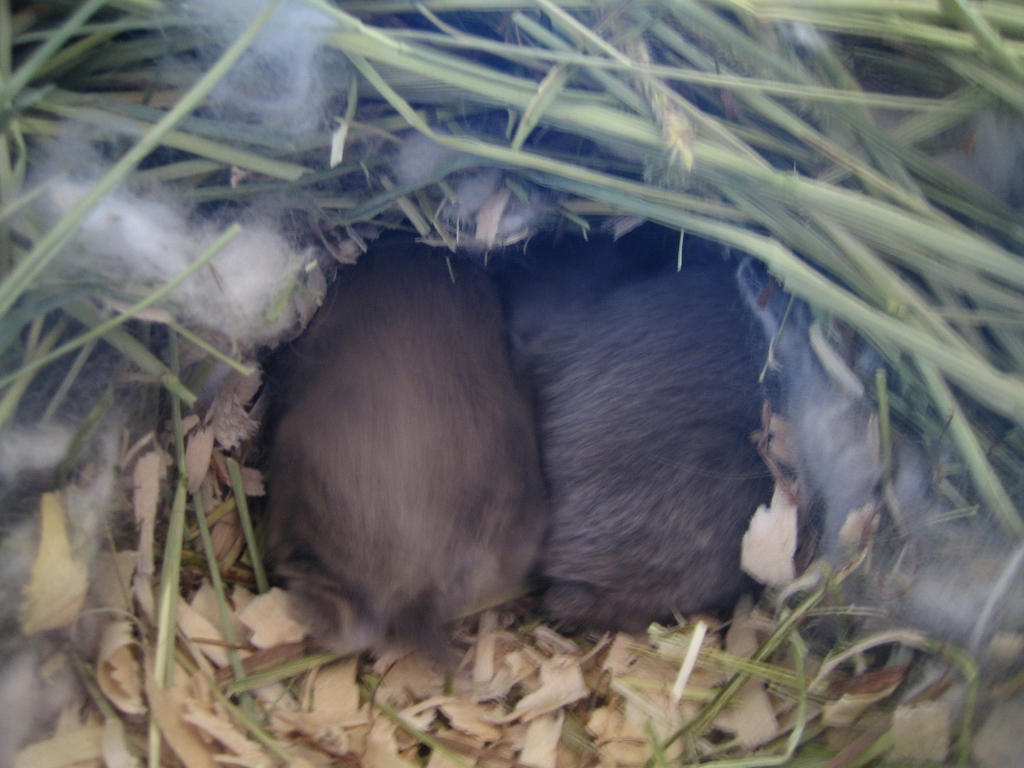
I'm pooped.  I spent the better part of the week getting up at 4:30 each morning to take the baby rabbits out to nurse, but once they hit 11 days and their eyes were open, I felt a little better about leaving them unsupervised overnight.  It is SOOOO nice to sleep through the night.  They are starting to move around the nest box a little and they really squirm when I pick them up, so it's hard to take a photo of them, but here are some I did manage to snap. 

This is what I see when I look in the nest box.  Baby butts!


Isn't this one just the sweetest!


This one was nibbling on hay while I was taking its picture.


And this one was exploring while its siblings were nestled in the background.


It has been raining non-stop and been very chilly most of the week, so there hasn't really been a good time to check the bees.  We've been keeping their feeder full of sugar water and have been patiently waiting to make sure the queen was released from her box and the bees have been drawing out comb.  I've watched them a few times during sunny periods and have seen pollen coming in, so I knew they were working.  Today, we finally had a good sunny warm day to open the hive and check its progress.

This frame is covered with bees, and you can see they've drawn out the comb from the top to the bottom.


This is a close-up of a frame with the bright yellow pollen they've been collecting over the past few days.


The main thing we wanted to see when we opened the hive was the queen, and this year, our queen is marked.  I was so happy to get a marked queen because to an untrained eye, she is really hard to find.  Do you see the neon blue dot?  That's our queen!


Now we just need our mentor to come by and make sure we aren't overlooking anything important.  He caught a swarm for us from one of his hives, so we should have a second colony soon as well.  Having two colonies really helps because it gives us a comparison.  We can check them against each other to help determine if one isn't doing as well as the other one. 

A friend of a friend was thinning out her ornamental flowers and offered us free plants, so we took advantage of the generosity and drove to her house today to get them.  Many of them are attractive to honeybees, so I am happy to have them.  We came home loaded down with plants, and I've spent most of today transplanting and did not even plant them all.  Finally at dark, I stopped. 

I do have one more project to share from today, but I'll share it next post.  I'm going to relax for the first time today.  Like I said, I'm pooped!

Happy homesteading,


Candace 

Monday, March 28, 2011

Weekend Recap

Lately it seems my posts have been full of bad and sad news, but sometimes, that's life I guess.  The good news is the baby I saved is fine.  I'm so thankful!  The bad news is we lost the runt Sunday morning.  After my scare Saturday morning, I brought the babies into the house for the day, so I could keep a close eye on them.  Olivia only feeds them once a day, so they weren't missing out on meal times.  I took them back out at dusk and left them there for a few hours and then brought them back in for the night.  I checked on them during the night, sleeping fitfully myself.  At 4:45, I took them back out to Olivia.  Apparently I waited too long to check on them again, because when I returned, the runt was on the floor of the cage dead.  Once again, I think it was still attached to Olivia's teat when she jumped out of the nest box.  So, last night we went through the same routine.  They were taken out at dusk and returned to the house for the night.  I took them out at 4:30 this morning, and Olivia immediately jumped in the nest box.  This time, I only waited 30 minutes and went back out.  Olivia had finished, and the three remaining kits were snuggled together as they should be.  I brought them back in the house anyway because it was pretty cold last night.  This morning I have three kits who seem to be thriving and growing each day.  Christine, my breeder friend, told me three out of six isn't bad.  She has lost whole litters.  Apparently, the survival rate of rabbits is not great.  I guess that's why they breed like rabbits to ensure good numbers.  They are just so vulnerable for the first week, and it doesn't take much to end a life.  I've been feeling really down about this, and I told Nate I'm a terrible pet owner.  He reminded me that for over two years, I've been making cat food from scratch for our cat, Lucy, who has CRF.  We know it has made a huge difference in her life, so I felt better after he said that.

On a brighter note, the three remaining kits are getting cuter everyday, and they celebrated their one week birthday last night.  Their eyes are still closed, but should be open by Wednesday.  This baby looks like it's going to be blue, like Mama and Daddy.  Looking at it in my hand makes me realize how much it has grown in a week.   


Yesterday was also eventful in that we started round two of our beekeeping adventure.  I think my mind was on the rabbits when we went to install the bees, because I did not put on my veil and neither did Nate.  We ALWAYS wear our veil and gloves.  It was cold and wet yesterday, so not the best conditions to be installing bees, and when the bees were shaken out of the box into the brood box, several of them swarmed up into the air and some of them landed on Nate's face.  Normally he is very calm around the bees, but he reacted in surprise and one stung him on the lip.We immediately went to the house and he took some antihistamine.  His lip started swelling, and I spent the whole morning asking him every five minutes if his breathing was normal, if his throat was itching, if he felt okay.  The car keys were on standby.  By the end of the evening, his lip had returned to normal size. 

I did get together with a friend and trade some seedlings and transplants yesterday.  I now have asparagus bean, european melon, amaranth, and jelly melon seedlings, and oregano, marjaram and creeping jenny divisions.  Most of these are new to me, and she got some varieties that are new to her.  I love bartering!  No money changed hands, and we got to hang out and talk about gardening and share ideas.   

I've had some harsh lessons this past week.  Sunday was a no good, horrible, very bad day with a slight silver lining!  I was asleep by 9:00 last night.   

Here's hoping for a better week,

Candace

Friday, March 18, 2011

Bees, The First Salad and A Good Read

I spoke with our beekeeping mentor earlier today, and he's coming by to get a hive box, top board and bottom board to catch a swarm for us.  I didn't ask him, but I think he's planning to capture a swarm from one of his colonies.  Plus, we should be getting a nuc from him in the next few weeks.  We are excited to get started with our beekeeping education again, because it is indeed a lesson in disappointment, patience, being in the moment, and hopefully, reward.  Here's to a better year in beekeeping.

I decided I couldn't take it anymore.  I am dying for a fresh salad, so I marched myself out to the lettuce bed, which is finally starting to look like something.  I picked enough mixed greens for a VERY small salad for each of us and then proceeded to the radishes and pulled some of those as well.  I think I'll add a few lemon balm leaves, a pinch of fresh thyme, sunflower seeds, chopped boiled eggs and oil and vinegar, which should be enough to slightly resemble a decent salad.   

I don't know where I've been, but I'm finally reading, Farm City, by Novella Carpenter.  She is now my new hero.  I love her humor especially.  I had to call my husband to read him the excerpt about her lesbian chicken, Agnes, who crowed.  It seemed so apropos in light of Vanilli crowing yesterday.  I am so inspired! 

I would love to know who inspires you and why. 

Happy homesteading,

Candace

Monday, February 28, 2011

Weekend Recap

The temperature topped out over 80 yesterday, and should hit around 80 today as well.  I'm afraid of what the summer will bring!  After today, it's back to the 60s during the day though.  It's so nice to be outside on a beautiful day, but the pollen is starting to fly, so being outside is a double edged sword for me. 

Our Pearl has been molting, so we haven't received an egg from her in a while, but she's back on her game.  Yesterday she laid, and she rejoiced all through the yard, loudly and proudly I might add.  She's a Black Star and is a wonderful layer.  I was reading a publication on chickens that stated all chickens stop laying during the winter unless you put lights in their coops.  We don't have lights, and ours laid through the winter.  We didn't get as many eggs as we do during the summer, but we did get 1-2 eggs a day.  I know the breed contributes, and we have a RIR, a Buff Orpington, a Black Star, a Barred Rock and a cross breed Brahma.  What is your experience with winter eggs? 

In addition to routine chores around the place, yesterday we started our spring yard redo.  We seem to do this every year as we decide certain plants may do better in another area of the yard.  Yesterday we relocated two lantanas, a rosemary bush, a Japanese maple, a pomegranate, some perennials and we potted a fig tree.  This fig tree was a rooting from some friends, and it just hasn't prospered where we planted it, so in an effort to rescue it from certain death, I decided to pot it for a while.  It's pretty small, and I've read that figs really like their roots kept confined to produce fruit.  I don't know if that's necessarily true, because I'm certain the fig tree across the street has not been confined in any way.  It's huge.  Potting the fig tree will help me keep a closer eye on it and give it some extra attention. 

A few weeks ago, I had a few tree services come over and give me estimates on taking down some of the trees in my neighbor's yard.  I've been going back and forth about spending that money, but we can get it done alot cheaper if they just drop the trees and leave them for us to cut up and dispose of.  It's ALOT of work on our end, but think of the money we save on gym membership.  Plus, one of them is an oak, and we can save it for firewood.  So, this weekend we really watched the sun to see how taking down three trees would benefit us.  I've been complaining about those trees for years, and now given the opportunity to take them down, I think I need to step up to the plate or stop complaining.  Plus, I think it will open up enough yard to start a small espaliered orchard.  If we go this route, we will have to sacrifice our current peach tree, which is another dilemma.  It really is a great tree, but I can espalier so many more fruit trees in the area it takes up.     

We checked on our bee supplies to make sure they were in good shape for our nuc delivery in a week or two.  We didn't find any evidence of wax moths, so I think we're in good shape. 

My ginger ale didn't really carbonate, but I think it's because I had it in the wrong-sized container.  I really need to get a 2-liter bottle and try again.  Either way, it tastes pretty good.  A nice change up from tea and water, for sure.  I think next time I may add a little more sugar because it has a bite to it that we didn't find enjoyable.  A little honey in my glass seemed to take the bite out though.

What did you accomplish over the weekend?

Happy homesteading,

Candace


Thursday, February 24, 2011

Buzz, Buzz

Do you know where your honey comes from and in whose hands it has been?  Probably the worst thing you can do is buy honey from the grocery store.  That honey comes from all over the world, and even if it's marked with the countries of origin, that information is sometimes false.  Grocery store honey could be tainted with any number of banned antibiotics used to keep the bees alive and disease and pest free.     

Chinese Honey Dumping

So, local honey seems to be the answer.  Not necessarily.  At our beekeeper's meeting this week, we learned about a popular method for treating hive beetles, using Max Force roach bait or any other roach bait that contains fipronil.  If you don't know, hive beetles are a part of beekeeping.  It's almost impossible to keep them out of the hives, so the best strategy is keeping them in check.  There are several safe methods of keeping them in check, but we were shocked to learn this method at our meeting, Okay, who in their right mind would put this in their bee hive knowing it's going to migrate to the wax and/or honey and then sell that honey to the public?  We also learned that someone local who sells honey at our farmer's market uses this method for his bees.  No names were given, but I do know who it's not.  Until we start producing our own honey, I know my source.   

My point is, like with any food you buy, know your source.  Ask questions.  If you don't like the answers, find another source.  You may not be able to source everything you buy, but making an effort to source what you can is better than doing nothing.

On a brighter note, we should be getting a couple of nucs in a few weeks, thus starting our beekeeping experience again.  Last year was such a failure for us, and several factors contributed.  This year we are starting with nucs, rather than package bees.  We are getting our bees much earlier in the year.  The weather last year kept the bee farms from shipping bees in time for the spring nectar flow and pollen.  Our inexperience also contributed to our failure.  So, we try again, and hopefully will stack the odds in our favor this time. 

I'll leave you with a picture Nate took last year of our bees.  I love this picture!


Happy homesteading,
 
 
Candace
Wednesday, July 28, 2010

Sometimes

While I would like to tell you growing your own food and trying to build an urban homestead is all peaches and cream, the truth of the matter is it's hard work and sometimes very frustrating and disappointing. Sometimes I wonder why I continue on this path, and then I see my chickens free ranging in the yard and I collect my eggs that weren't laid in a cage in a building with artificial lights, and I know for me, it's the right thing to do. I am determined to continue to grow and learn and take the good with the bad. However, sometimes we focus so much on our perceived disappointments and failures, we fail to see what we've accomplished and be thankful for it. So, I thought I would take a moment to look back on some things I'm proud to have accomplished this year. We added two new chickens to the flock, bringing it to four. We built the fabulous GA State Henitentiary, moving the girls from the chicken tractor to larger digs. We continue to get 1-2 eggs a day from Pearl and Vanilli and look forward to getting eggs from Thelma and Louise starting maybe the end of August. We started two bee hives, and while not a complete success, a valuable learning experience indeed. We added a rain barrel to the front of the house making it easier to water the veggies up front. We built and planted 7 raised beds in the front yard for vegetables. I have canned Fig Cognac Jam and Pepper Jelly. I have dried numerous trays of peppers, hot and sweet, and figs. Our blueberry bushes, planted last summer, gave us a decent harvest, enough to make some muffins and to throw some on cereal in the morning. I have frozen numerous cubes of basil from the garden, the wild blackberries we were able to pick in the spring and pureed figs. I've made and frozen several jars of jalapeno pepper sauce and bacon-wrapped stuffed jalapenos. Several jars of refrigerator pickles sit in the refrigerator as well.

By our standards, wow, what a list, with five months left to go in the year.

There are other non farm-related things for which I'm am thankful as well, but that's another post.

Happy homesteading,

Candace

Monday, June 21, 2010

Weekend Recap


We had a busy weekend, and I couldn't seem to find any time to write a post, so I thought a weekend recap might serve to highlight some of the happenings at our little urban farm. In addition to garden maintenance and cleaning the coop, here's what you missed.

My zucchini plants were attacked by squash vine borers, and since this has never happened to me before, I caught it too late. I have one zucchini plant that is barely hanging on and a few squash plants that don't seem to be affected. So I replanted some zucchini seeds and hope for a late summer harvest. Late is better than nothing, so we'll see what happens. I was fortunate enough to be given some zucchini by a co-worker last week, so this weekend I made the most of it. I used some of it to make veggie burgers for the freezer. We love these burgers, and they are WAY better than the frozen burgers at the store. They have saved my life more than once for a quick fix when I'm too tired to cook. The rest of it I used to make zucchini cakes one night for supper and also an ingenious recipe for mock 'apple' pie. Amazingly this pie, using zucchini, tastes like apple pie.

The same co-worker also gave me some cucumbers, not enough to go to the trouble of canning, but just enough for some refrigerator pickles. If you've never made refrigerator pickles, you should give them a try! Easy to make and delicious to eat!

My jalapeno plants are rocking right now, so I sliced up at least a couple dozen peppers and threw them on the dehydrator. I could have canned them, but I dried some jalapenos last year to see how I would like them, and they worked wonderfully for many recipes, so I think drying them is the way to go for me. Plus, I put the dehydrator outside on my deck and it doesn't heat up my kitchen like canning would.

All work and no play makes me a dull girl, so we hit the town Saturday night and went to the ASA BMX Big Air Triples Competition. Wow, seeing a double front flip on a BMX bike is amazing. This kid did 3 or 4 double front flips throughout the night and each time made it seem so easy. And he's only 15. I wish I had that much talent going for me at 15.

We got up early to go wild blackberry picking on Sunday. We have a couple of places we go, but our favorite is a huge field full of blackberries canes. This is what we found when we arrived.


THE CITY MOWED THE WHOLE FIELD TO THE GROUND! Add on the fact that it has been extremely hot and dry lately and the disappointment mounts because most of the berries we did find were dried up. We have been able to pick about 2 quarts, but that is nothing compared to what we usually pick. I put them in the freezer for now and will use what little I have from last year to make some blackberry jam.

We checked our bees last night, by ourselves, without our mentors. Going solo with no supervision is a big deal in our book. We took our time and looked at each frame for signs of queen cells, new eggs being laid, and capped brood and honey. Everything seems to be going smoothly. It was definitely very intimidating as the population has grown with new bees hatching daily. It seems like we have a good productive queen though.

Who says cats and chickens can't get along? Here, OP2 and Pearl share a leftover biscuit from breakfast.


Until next post, happy homesteading,


Candace